
Advance tax: the dates and the amounts, worked through
The rule
- Who: anyone whose tax for the year, less TDS, is ₹10,000 or more. A resident aged 60 or over with no income from a business or profession is exempt.
- When: by 15 June, 15%; by 15 September, 45%; by 15 December, 75%; by 15 March, 100%. Each is a share of the year's tax, less TDS, paid by then in all.
- A gain mid-year: tax on a capital gain made after an instalment's date can be paid in the instalments that remain, with no interest for the ones before it.
- Presumptive business income (section 44AD or 44ADA): all of it by 15 March.
A worked example
A salary of ₹18,00,000, on which the employer deducts the year's tax as TDS, ₹1,50,800 in the new regime. In the year the person also sells shares for a short-term gain of ₹3,00,000, taxed at 20% plus cess:
| For the year | |
|---|---|
| Income tax on the salary (new regime) | ₹1,50,800 |
| Tax on the short-term gain, with cess | ₹62,400 |
| Tax for the year | ₹2,13,200 |
| TDS on the salary | −₹1,50,800 |
| Left to pay | ₹62,400 |
The ₹62,400 left after TDS is more than ₹10,000, so it is due in advance:
| By | Share | Paid by then | This instalment |
|---|---|---|---|
| 15 Jun 2026 | 15% | ₹9,360 | ₹9,360 |
| 15 Sep 2026 | 45% | ₹28,080 | ₹18,720 |
| 15 Dec 2026 | 75% | ₹46,800 | ₹18,720 |
| 15 Mar 2027 | 100% | ₹62,400 | ₹15,600 |
Below ₹10,000
With a short-term gain of ₹40,000 instead, the tax on it is ₹8,320, less than ₹10,000: no advance tax is due, and it is paid with the return.
How Pocket works it out
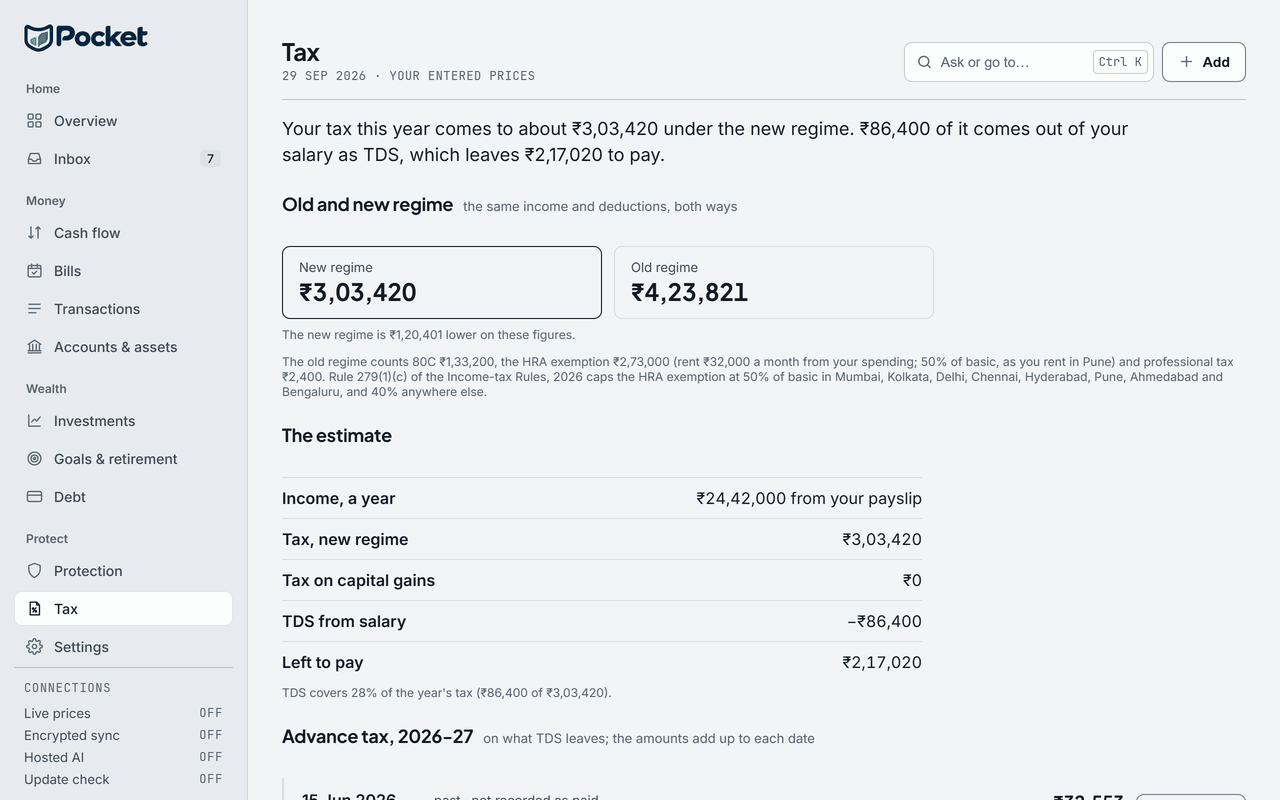
Pocket's Tax page works out the year's tax in the lower regime, adds the capital-gains tax on the year's sales, takes away the TDS on your payslips, and, when what is left is ₹10,000 or more, shows the four dates with the amount due by each. Its reminders say each date and amount a week before, and for a date that has passed with no payment recorded it gives the section 234C interest, about 1% a month on the shortfall. It is a planning estimate, not a tax return: the Income Tax Department and a chartered accountant have the final word.
Questions
Who pays advance tax?
Anyone whose tax for the year, less the TDS deducted, is ₹10,000 or more. A resident aged 60 or over with no business income does not.
What are the advance tax dates for FY 2026-27?
15 June, 15 September and 15 December 2026, and 15 March 2027: by then 15%, 45%, 75% and 100% of the year's tax, less TDS, is due.
Does a salaried person pay advance tax?
Only on what the employer's TDS does not cover, such as capital gains or interest. In the example, a short-term gain of ₹3,00,000 leaves ₹62,400 to pay in advance.
What happens if an instalment is short?
Interest of 1% a month on the shortfall (section 234C), and 1% a month on what is unpaid after 31 March if less than 90% was paid in advance (section 234B). Pocket works out section 234C's interest on a date that has passed with no payment recorded; it does not work out 234B's.
Sources
- Income Tax Department: the Acts, rules, circulars and its own tax calculator, at incometaxindia.gov.in
- Income-tax Act, 2025, which replaces the Income-tax Act, 1961 from 1 April 2026 (FY 2026-27); the 1961 Act's section numbers are given too, as most forms and payslips still use them
- Finance Act, 2025: the new regime's slabs and the ₹12 lakh rebate, from FY 2025-26; and Finance Act, 2026 (Budget 2026), which left the slabs, the rebate and the surcharge as they were for FY 2026-27
- Income-tax Act, 1961, sections 207, 208 and 211: who pays advance tax, the ₹10,000 threshold and the four dates; sections 234B and 234C: interest on a shortfall
Pocket is free on Windows, macOS, Linux and Android, and keeps everything on your own device: download Pocket.