
NPS and 80CCD(1B), worked through
The three NPS deductions
- 80CCD(1): your own contribution, inside 80C's ₹1,50,000 limit.
- 80CCD(1B): ₹50,000 more of your own contribution, beyond 80C. Old regime only.
- 80CCD(2): your employer's contribution, up to 14% of basic and dearness allowance in the new regime (10% in the old). The only one the new regime allows. Pocket does not work it out.
The deduction is for contributions to an NPS Tier I account. A Tier II account has no deduction (except the central government's own scheme for its employees) and no lock-in.
What ₹50,000 under 80CCD(1B) does to the year's tax
| Old, 80C only | Old, 80C and 80CCD(1B) | |
|---|---|---|
| Salary | ₹18,00,000 | ₹18,00,000 |
| Standard deduction and 80C | −₹2,00,000 | −₹2,00,000 |
| 80CCD(1B) | not claimed | −₹50,000 |
| Taxable income | ₹16,00,000 | ₹15,50,000 |
| Tax for the year, with cess | ₹3,04,200 | ₹2,88,600 |
The ₹50,000 comes off income taxed at 30%, so the old regime's tax is ₹15,600 lower. On the same salary the new regime, which allows no 80CCD(1B), comes to ₹1,50,800; the old vs new regime guide works through where the old regime's deductions start to cost less.
What ₹5,000 a month could grow to
₹60,000 a year, ₹5,000 a month paid at the start of each month, at an assumed 10% a year (Pocket's planning default):
| For | Put in | Corpus at 10% |
|---|---|---|
| 15 years | ₹9,00,000 | ₹20,89,621 |
| 25 years | ₹15,00,000 | ₹66,89,452 |
| 35 years | ₹21,00,000 | ₹1,91,41,384 |
At other rates, over 25 years:
| Return | Corpus after 25 years |
|---|---|
| 8% a year | ₹47,86,833 |
| 10% a year | ₹66,89,452 |
| 12% a year | ₹94,88,175 |
These are projections on an assumed return, not a promise: NPS is invested in equity, corporate bonds and government securities, and its value goes down as well as up.
At 60
The corpus is locked in until 60. At exit, part can be taken as a lump sum and the rest buys an annuity, a pension whose income is taxed as it is paid; PFRDA's exit rules set the shares, and the Income-tax Act sets how much of the lump sum is tax-free. Pocket's projection stops at the corpus.
How Pocket works it out
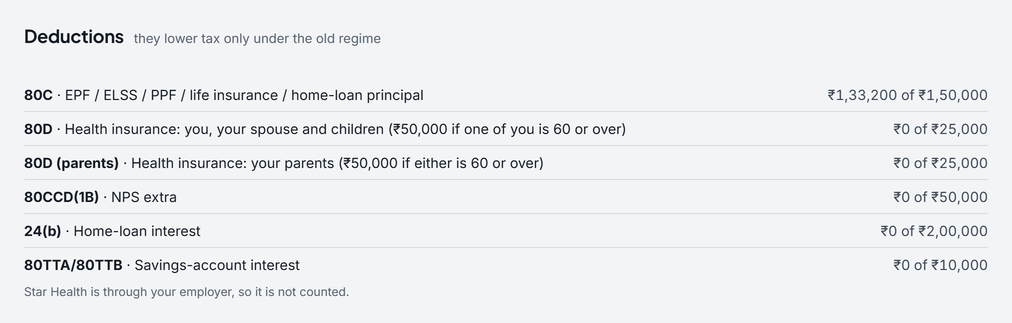
Pocket's Tax page lists 80CCD(1B) in its deduction tracker with its ₹50,000 limit, what is used and what is left. The growth figures above come from Pocket's planning engine, which pays each month's contribution at the start of the month, as it does for a SIP. It is a planning estimate, not a tax return: the Income Tax Department and a chartered accountant have the final word.
Questions
How much does 80CCD(1B) deduct?
Up to ₹50,000 a year of your own NPS contributions, in the old regime only, on top of 80C's ₹1,50,000.
Is 80CCD(1B) allowed in the new regime?
No. The new regime allows only the employer's contribution to NPS, under 80CCD(2), up to 14% of basic and dearness allowance.
What does the 80CCD(1B) deduction save on ₹18,00,000?
In the old regime, with 80C already full, ₹15,600: ₹50,000 that would have been taxed at 30%, plus cess.
What could ₹5,000 a month in NPS grow to in 25 years?
₹66,89,452 at 10% a year, an assumption and not a promise; ₹47,86,833 at 8% and ₹94,88,175 at 12%.
Sources
- Income Tax Department: the Acts, rules, circulars and its own tax calculator, at incometaxindia.gov.in
- Income-tax Act, 2025, which replaces the Income-tax Act, 1961 from 1 April 2026 (FY 2026-27); the 1961 Act's section numbers are given too, as most forms and payslips still use them
- Finance Act, 2025: the new regime's slabs and the ₹12 lakh rebate, from FY 2025-26; and Finance Act, 2026 (Budget 2026), which left the slabs, the rebate and the surcharge as they were for FY 2026-27
- Income-tax Act, 1961, section 80CCD(1), (1B) and (2): NPS contributions, the extra ₹50,000, and the employer's contribution
- Pension Fund Regulatory and Development Authority (PFRDA): NPS and its exit rules
Pocket is free on Windows, macOS, Linux and Android, and keeps everything on your own device: download Pocket.