
The ₹1.25 lakh LTCG room, worked through
The rule
A long-term capital gain on listed shares, and on units of funds and ETFs that hold Indian equity, is taxed at 12.5% on what is above ₹1,25,000 in the financial year (1 April to 31 March), plus 4% cess. The ₹1,25,000 is the year's total across every sale, not each sale's. It applies in both regimes, and a sale's gain counts in the year of the sale.
The room at different gains
| Equity long-term gains booked | Room left | Tax on them, with cess |
|---|---|---|
| ₹0 | ₹1,25,000 | ₹0 |
| ₹40,000 | ₹85,000 | ₹0 |
| ₹1,25,000 | ₹0 | ₹0 |
| ₹2,00,000 | ₹0 | ₹9,750 |
Up to ₹1,25,000 of gains in the year, the tax is nil; above it, each rupee is taxed at 13 paise (12.5% plus cess).
What is long-term in a holding now
A fund bought in two lots: 400 units on 3 Mar 2025 at ₹250 and 200 units on 1 Jan 2026 at ₹300. At a price of ₹330 on 12 Oct 2026:
- Long-term now: the March 2025 units, held over 12 months, carry a gain of ₹32,000.
- Short-term now: the January 2026 units carry ₹6,000; they turn long-term on 2 Jan 2027.
Because units are sold oldest first, a sale of up to 400 of these units would draw only on the long-term lot. A gain booked inside the room is taxed at nil. Selling units and buying the same fund back, sometimes called harvesting, books the gain inside the year's room and starts the new units' cost at the price paid; it also starts a new holding period. Pocket reports each lot's gain and term; it does not suggest a sale.
How Pocket works it out
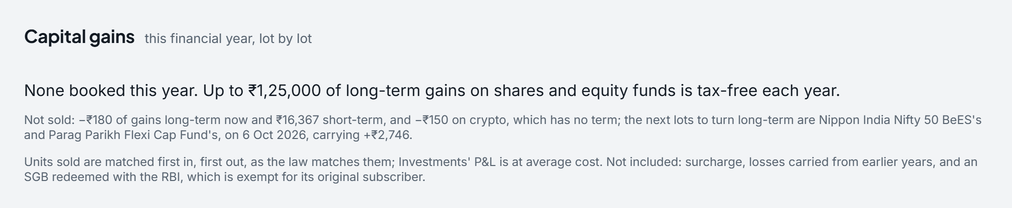
Pocket's Tax page lists the year's gains by term, notes that the first ₹1,25,000 of the equity long-term gains is tax-free, and, for each holding, shows the gain that is long-term now, the gain that is still short-term, and the next date a lot turns long-term, at the prices you entered. The room left is the ₹1,25,000 less the year's equity long-term gains. It is a planning estimate, not a tax return: the Income Tax Department and a chartered accountant have the final word.
Questions
How much equity long-term gain is tax-free in FY 2026-27?
The first ₹1,25,000 of long-term gains on listed shares and equity funds in the financial year; what is above it is taxed at 12.5%, plus cess.
Does unused room carry over to the next year?
No. The ₹1,25,000 is for each financial year; what is not used by 31 March is gone.
Does it cover gold ETFs or debt funds?
No. It is for equity: listed shares, and funds and ETFs that hold Indian equity. A gold ETF's long-term gain is taxed at 12.5% from the first rupee.
How much room is left after ₹40,000 of gains?
₹1,25,000 − ₹40,000 = ₹85,000.
Sources
- Income Tax Department: the Acts, rules, circulars and its own tax calculator, at incometaxindia.gov.in
- Income-tax Act, 2025, which replaces the Income-tax Act, 1961 from 1 April 2026 (FY 2026-27); the 1961 Act's section numbers are given too, as most forms and payslips still use them
- Finance Act, 2025: the new regime's slabs and the ₹12 lakh rebate, from FY 2025-26; and Finance Act, 2026 (Budget 2026), which left the slabs, the rebate and the surcharge as they were for FY 2026-27
- Income-tax Act, 1961, section 112A, and the Income-tax Act, 2025's section in its place: long-term gains on equity, 12.5% above ₹1,25,000 a year
Pocket is free on Windows, macOS, Linux and Android, and keeps everything on your own device: download Pocket.